When to use a rotating telehandler instead of a crane
When to use a rotating telehandler instead of a crane
What is a rotating telehandler and how it works
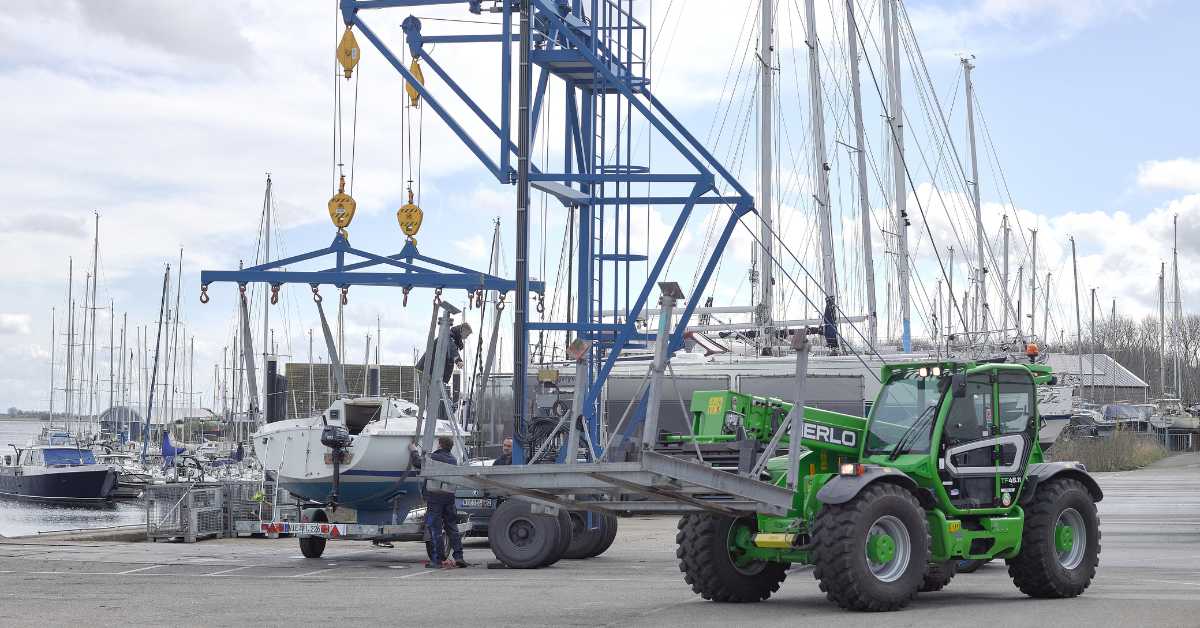
A rotating telehandler is a machine designed for lifting and handling materials, distinguished by the presence of a 360° rotating turret capable of operating without the need to constantly reposition the machine. Unlike traditional models, this type of machine combines the functions of a telehandler, a crane and an aerial work platform in a single solution, making it exceptionally versatile in modern construction site environments.
From a technical perspective, a rotating telehandler is equipped with an extendible telescopic boom mounted on a rotating turret, enabling it to reach even the most complex work areas while keeping the machine stable. The stabilisers ensure safety during operations by adapting to different ground conditions, while the numerous interchangeable attachments (such as hooks, forks and aerial work platforms) allow the machine to be quickly configured to meet the operational requirements.
The main difference compared to a fixed-boom telehandler lies precisely in the turret’s ability to rotate, eliminating the need to constantly reposition the machine to change work areas. This results in greater operational efficiency, particularly on construction sites where space is limited or operations are varied and frequent.
Key differences between a rotating telehandler and a crane
When comparing rotating telehandlers and cranes, one key difference immediately stands out: the former is designed to deliver maximum operational versatility, while the latter is intended for more static and specialised lifting operations. This distinction has a direct impact on productivity, costs and site organisation.
From a structural point of view, a crane is a fixed or semi-fixed machine that requires considerable time for assembly and dismantling, as well as precise space planning. A rotating telehandler, on the other hand, is an autonomous and mobile machine, ready for use within minutes, capable of moving easily around the site and adapting to different operational requirements without interruption.
Another key factor is mobility: while the crane operates from a fixed position and covers a working area limited by its installation, the rotating telehandler enables work to be carried out across multiple areas without complex repositioning, thanks to the turret’s rotation and its ability to move across the ground. This leads to more dynamic site management, which is particularly valuable in urban settings or where space is restricted.
Operational times are also a decisive factor: installing a crane entails significant costs and time, whereas the rotating telehandler is immediately operational and can be used for various tasks throughout the same day. This speed helps reduce downtime and improve overall efficiency.
Finally, the true strength of the rotating telehandler lies in its versatility. Thanks to its interchangeable attachments, it can perform tasks that would normally require multiple machines: material lifting, handling and work at heights.
Limitations of traditional cranes on modern construction sites
On modern construction sites, which are increasingly focused on speed, efficiency and space optimisation, traditional cranes present several clear operational limitations that can slow down work and increase overall costs. Although they remain essential in specific contexts, they are not always the most flexible solution.
One of the main constraints relates to workspace requirements: cranes need dedicated areas for assembly and operation, which are often difficult to secure on urban sites or in congested environments. This lack of flexibility makes logistics management more complex, especially when the site is evolving rapidly or involves multiple operational zones.
Added to this is the need to use multiple machines for different tasks. A crane is primarily designed for vertical lifting, but is not well suited to dynamic handling or work at heights involving operators. This results in an increase in equipment, operators and coordination, leading to higher costs and greater management complexity.
Another critical aspect concerns assembly and dismantling times, which can significantly affect the duration of the project. Installation requires specialised personnel, planning and often permits, leading to downtime that slows the progress of the work.
Finally, the crane offers limited operational flexibility: once installed, it remains fixed to a specific position and work area. In a context where construction sites increasingly demand adaptability and rapid response times, this limitation can lead to reduced overall productivity.
When to choose a rotating telehandler: practical use cases
Understanding when to use a rotating telehandler instead of a crane means analysing the situations in which flexibility, speed and versatility truly make a difference. On modern, increasingly dynamic construction sites, there are scenarios in which this machine represents a highly effective strategic choice.
One of the clearest examples is urban construction sites or those with confined spaces, where installing a crane can be complex or even impossible. In these contexts, the rotating telehandler enables operations within confined areas, making full use of the 360° rotation while minimising the space required. This results in greater logistical efficiency and a reduction in operational challenges.
Another ideal scenario involves multi-purpose work, where it is necessary to switch quickly between different tasks: material lifting, handling and work at heights involving operators. Thanks to interchangeable attachments, the rotating telehandler enables rapid transitions from one function to another, eliminating the need to use multiple machines. The result is a simplified construction site and a significant reduction in operating costs.
The rotating telehandler is also particularly advantageous on sites characterised by frequent operational changes, where requirements evolve rapidly throughout the day. In such cases, the ability to adapt in real time helps maintain high productivity while avoiding delays and downtime.
Finally, it is the ideal solution for rapid interventions that do not require complex set-up. Unlike a crane, which requires installation and planning, the rotating telehandler is immediately operational, allowing work to begin quickly and with greater autonomy.
Advantages of the rotating telehandler
The rotating telehandler stands out in the construction machinery sector for its unique combination of advanced technical features and tangible benefits, making it a strategic choice for industry professionals.
In terms of features, the rotating telehandler offers continuous 360° rotation, a high-precision extendible telescopic boom and a wide range of interchangeable attachments. Added to these are advanced stabilisers, which ensure safety and adaptability even on complex terrain, along with sophisticated technological systems for load and operation control.
These features translate into tangible operational benefits: the ability to use a single machine for multiple applications, reduced downtime thanks to rapid reconfiguration, and greater efficiency thanks to the ability to operate without constant repositioning. The result is a smoother, more organised and productive construction site.
The benefits for the end user are even more significant: a substantial reduction in operating costs thanks to the lower number of vehicles required, shorter working times, and improved overall safety thanks to integrated systems and simplified operation management. Moreover, optimising resources helps make the construction site more sustainable and efficient, in line with modern industry requirements.
The Merlo rotating telehandler is not just a machine, but a complete solution that enables you to work better, faster and with greater control, offering a practical response to the challenges of today’s construction sites.
The Merlo rotating telehandler: innovation and safety
In the world of telehandlers, Merlo models set the benchmark thanks to a combination of technological innovation, advanced safety and a strong focus on sustainability. The company stands out for its solutions designed to effectively meet the needs of modern construction sites, which are increasingly focused on efficiency, precision and risk reduction.
One of the key elements is the integration of intelligent electronic operation control systems, which allow the operator to work with maximum precision and full awareness of the loads being handled. Technologies such as load and stability management systems help ensure safe operations even in the most demanding conditions, reducing the margin for human error.
Safety is further enhanced by design solutions that improve machine stability and operator visibility, both fundamental elements when working in dynamic and often critical environments. The cab is designed to provide high levels of comfort, ergonomics and total control, enabling the operator to maintain high productivity even during prolonged use.
In terms of innovation, Merlo continuously invests in the development of sustainable technologies, with the aim of reducing fuel consumption and emissions without compromising on performance. This approach results in machines that are not only high-performing but also compliant with the environmental regulations and the demands of a more responsible construction industry.
How to make the right choice between a crane or a rotating telehandler
Choosing between a crane and a rotating telehandler is not merely a technical matter, but a strategic decision that affects efficiency, costs and productivity on site. To determine the most suitable solution, it is essential to analyse several key parameters, starting with the required operational specifications.
The first factor to consider is the type of work: if the activity mainly involves continuous vertical lifting at significant heights, a crane may be the more suitable option. Conversely, if the site requires frequent handling, varied operations and greater adaptability, the rotating telehandler is a more efficient and modern choice.
Another determining factor is the available space. In large, well-structured environments, a crane can operate without any particular limitations; however, in complex or confined spaces, the rotating telehandler offers greater operational freedom thanks to its mobility and ability to work without fixed installations.
Cost and time analysis is also crucial: the crane entails a higher initial investment and significant assembly times, while the rotating telehandler enables an immediate reduction in operating times and more flexible resource management. This translates into a better return on the investment, particularly on dynamic construction sites.
Finally, it is important to assess the frequency and variety of the operations. If the site involves repetitive and standardised activities, a crane may be sufficient; however, if the requirements change frequently, the rotating telehandler enables real-time adaptation, ensuring continuity and productivity.
Contacts
Do you need to request information or receive clarification on Merlo products and service? Contact us!
Commercial branch
Merlo UK Limited
Headlands Business Park - BH24 3PB
Ringwood Salisbury Rd, Blashford - United Kingdom
TEL01425 480806
FAX01425 477478
EMAILinfo@merlo.co.uk